AfCFTA 20262 mars 2026
AfCFTA Year 5: How Cameroonian SMEs Can Export to Other African Markets in 2026
fnmalic
Auteur
8 min de lecture

fnmalic
Auteur
Five years ago, African heads of state signed one of the most ambitious trade agreements in modern history. The African Continental Free Trade Area — AfCFTA — promised to unite 54 countries, 1.4 billion consumers, and a combined GDP of $3.4 trillion into a single market.
For most Cameroonian SMEs, it stayed a headline. A government announcement. Something for big corporations with legal teams and export departments.
That era is over.
In 2026, AfCFTA is no longer theoretical. We have proof. Real companies. Real shipments. Real money crossing real borders under this agreement — and some of those companies are right here in Cameroon.
Let's start with facts, not promises.
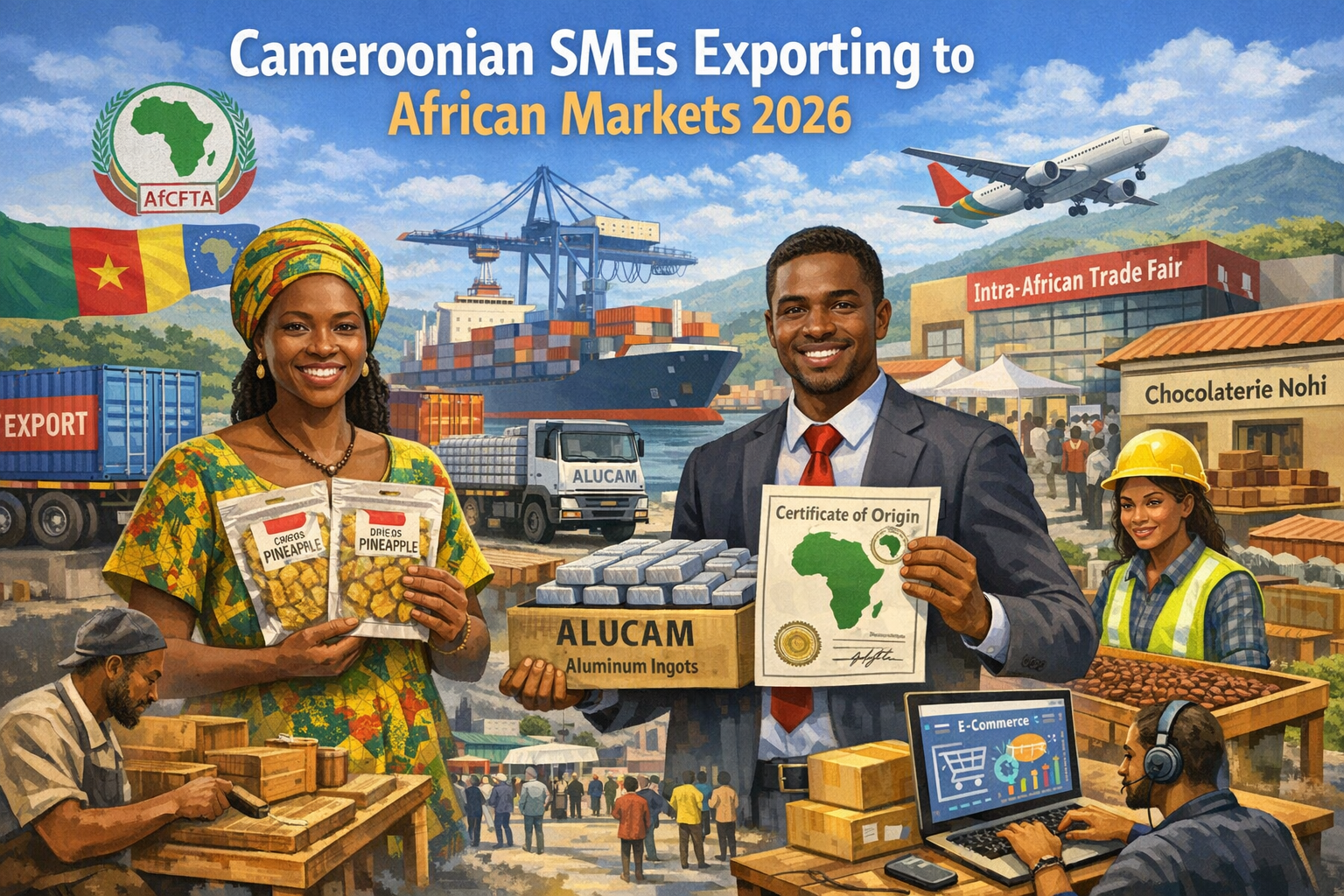
In October 2022, Cameroon issued its very first AfCFTA certificate of origin. The beneficiary was GIC/Gig Afatex, a local agri-processing company that shipped dried safflower, pineapple and ginger to Ghana — at zero duty. That same year, Cameroon Tea Estate and Ndawara Tea Estate exported over 38 kilograms of locally produced tea to Ghana under AfCFTA preferential rules.
These were not large corporations. These were Cameroonian SMEs. And they went first.
By mid-2024, the scale grew. Alucam — Cameroon's aluminum producer — shipped 99.4 tons of aluminum ingots to Algeria under AfCFTA preferential rates. And on the import side, paint-maker INODA Industries used a 30% duty cut to import resin from Tunisia in July 2023, reducing their production costs immediately.
The infrastructure is catching up too. The government has published e-tariff schedules and begun phased tariff cuts. The African Trade Observatory is now a functional tool that Cameroonian entrepreneurs can use to identify markets and check applicable tariffs. Kenya's new "BiasharaLink" platform (launched in 2026) is turning African embassies into trade hubs. WTO ministers are meeting in Yaoundé in March 2026 specifically to focus on digital trade for SMEs.
Training is spreading. The Cameroon Economic Policy Institute (CEPI), ITC, and the National Shippers' Council trained over 80 Cameroonian SMEs in AfCFTA trade tools in 2024 alone. Participants learned rules of origin, export documentation, and digital marketing to reach new African markets.
AfCFTA in 2026 is real. It is not perfect.
Intra-African trade represents only about 15% of Cameroon's total trade today. Many African neighbors have not yet finalized or implemented their own tariff schedules. Cameroon's membership in the CEMAC customs union — which carries a 15% common external tariff — means some product categories are still technically taxed even under AfCFTA.
A concrete example of the friction: traders reported that a planned import of Nigerian fertilizer could not use AfCFTA preferences because Nigeria had not finalized its tariff schedules for that product category. The agreement exists. The implementation is uneven.
Logistics remain a serious challenge. Export processing at the Port of Douala now takes twice as long as it did in 2015 — a competitiveness problem that AfCFTA cannot fix on its own. Infrastructure, harmonized standards, and wider country-level implementation are still needed before the full promise of the agreement arrives.
The honest CEO verdict: AfCFTA is a genuine opportunity, not a magic bullet. The SMEs that win will be the ones who prepare carefully and move early — not the ones who wait for every barrier to disappear.
This is where Cameroonian SMEs have already proven the model works.
Gig Afatex shipped ginger, pineapple and safflower to Ghana. Cameroon Tea Estate and Ndawara Tea Estate exported local tea. At the 2025 Intra-African Trade Fair in Algiers, the National Shippers' Council showcased Made-in-Cameroon products from companies including Authentic Foods Cameroon, Family Food, Jaof Food, GIC Anab, and Nohi Chocolaterie.
The category is strategically positioned. Agro-processed foods classified as "Category A" goods — products not produced within CEMAC — are slated for rapid tariff cuts, making them prime export targets. Think packaged cocoa products, dried fruits, artisanal coffee, spices, sauces, and snacks.
The path is clear. The proof of concept exists. Other SMEs in agri-processing simply need to follow the same steps that Gig Afatex and Cameroon Tea Estate took.
Cameroon's raw materials leave the country and the value stays elsewhere. AfCFTA creates an opportunity to change that equation.
Alucam's shipment of 99.4 tons of aluminum ingots to Algeria demonstrates real continental demand for processed Cameroonian materials. Sawmills and furniture manufacturers could export lumber and finished wood products under zero or reduced duty. Cement, kaolin, and bauxite producers can target African markets once goods are sufficiently processed. INODA Industries' experience with resin imports shows that CEMAC industrial plants are actively seeking inputs — which means there is a two-way opportunity in industrial materials.
One note of caution: some "sensitive" resource categories have gradual tariff phase-outs under CEMAC liberalization schedules. Check the specific schedule for your product category before building an export business plan around a tariff rate that may change.
Light manufactured goods have continent-wide appeal and relatively low barriers to cross-border shipping compared to raw materials.
The IATF 2025 showcase in Algiers demonstrated real demand for Made-in-Cameroon consumer products across agrifood, textiles, and lifestyle categories. Niche markets are particularly promising — artisanal coffee, shea-based cosmetics, cocoa snacks, packaged beverages, and handcrafted goods that carry the story of Cameroonian origin as part of their value proposition.
Africa's e-commerce market is expected to surpass half a billion users, and physical consumer goods sold through digital platforms represent a growing cross-border channel that did not exist at meaningful scale five years ago.
If your business is digital — software, subscriptions, consulting, training, creative services, or data — you are already operating in a borderless market. AfCFTA's Digital Trade Protocol is specifically designed to formalize and protect this.
Cameroonian startups are already leading the way. Kiro'o Games, Waspito HQ, and Ejara are each serving customers across five or more African countries. New platforms like Kenya's BiasharaLink and forthcoming AfCFTA digital trading portals will make it easier for SMEs to transact across borders with formal protections.
For digital service businesses — including professional email providers, SaaS tools, HR platforms, accounting software, and consulting services built for the CEMAC market — the export opportunity is immediate. Your marginal cost of serving a client in Libreville or Kinshasa versus Douala is essentially zero. Your product is already built for the local regulatory and cultural context that international competitors cannot easily replicate.
CEPI's AfCFTA research is clear: winning African export markets requires market knowledge, operational capacity, and regulatory compliance working together.
Market research and strategy. Use the African Trade Observatory to identify which countries have demand for your product and what tariff rates apply. Target at least two countries initially. Study competitor pricing and regulatory requirements before committing resources.
Trade documentation and compliance. Exporting under AfCFTA means following rules of origin. Your business must register with the National Shippers' Council and obtain an AfCFTA Certificate of Origin for each shipment — exactly as Gig Afatex and Cameroon Tea Estate did. Products must meet destination country quality, phytosanitary, and packaging standards. The Cameroon Trade Hub and professional customs agents can help you navigate the paperwork correctly the first time.
Production capacity and quality certification. Many Cameroonian SMEs are strong locally but under-resourced for export volumes. Consider partnerships, cooperatives, or contracted capacity to meet larger orders. ISO and HACCP certification for food products will open doors that informal production cannot. CEPI's AfCFTA workshops cover exactly these practical skills.
Trade finance and incentives. Export orders often require upfront investment in raw materials, larger production runs, and shipping costs before payment arrives. Afreximbank offers trade finance lines specifically for AfCFTA exporters. Development banks and microfinance institutions like Prima Finance (which co-hosted CEPI's training) can assist with trade loans. Cameroon's 2026 budget also provides payroll tax breaks for companies that hire young workers — a meaningful cost reduction if you are scaling up operations for export.
Professional digital presence. Before a buyer in Libreville, Accra, or Nairobi sends you money, they will look you up. They will visit your website. They will email you. If your business email is @gmail.com or your website looks informal, they will move to the next supplier — probably not from Cameroon. A professional email address, a clean website, and responsive communication are not optional for export. They are the first filter every international buyer applies.
Networking and partnerships. The Cameroon National Shippers' Council actively invites SMEs to continental trade fairs and B2B events. Eighty SMEs attended the 2024 AfCFTA training fair and made deals. The IATF 2025 in Algiers connected Cameroonian producers with buyers across the continent. These events are not optional extras — they are how export relationships are built in practice.
Based on the framework validated by CEPI, ITC, and the Shippers' Council with Cameroonian exporters:
Weeks 1–2 — Market Scan
Use the African Trade Observatory to identify one or two African countries with proven demand for your product. Check import tariffs under AfCFTA. Research Cameroonian competitors already selling there to understand pricing and positioning.
Weeks 3–4 — Compliance Check
Verify your product qualifies for AfCFTA preferential treatment under rules of origin. Register with the National Shippers' Council. Prepare the paperwork for a Certificate of Origin. Confirm your product's packaging and quality standards meet destination country requirements.
Weeks 5–7 — Prepare Production
Line up your supply chain and partner relationships to meet export volumes. Apply for any required quality certifications. If hiring additional staff, take advantage of Cameroon's 2026 payroll tax breaks for young worker employment.
Weeks 8–9 — Engage Buyers
Attend a trade event or use online B2B platforms to connect with importers. Use the Cameroon Trade Hub to find verified buyers. Establish a relationship with a distributor or direct importer in your target country. Cameroonian SMEs at IATF 2025 in Algiers used exactly this approach to make deals.
Weeks 10–11 — Arrange Logistics
Plan your shipment route — Douala port, Kribi port, or overland CEMAC corridors depending on destination. Get shipping and insurance quotes. Secure trade financing or confirm upfront payment terms. Use the GUCE Single Window system to declare exports.
Week 12 — Pilot Shipment
Dispatch a small first shipment under AfCFTA terms. Ensure all documents accompany the cargo: commercial invoice, AfCFTA Certificate of Origin, export license. Track the shipment and confirm arrival. Collect the buyer's feedback.
Week 13 — Review and Scale
Analyze every outcome. Was delivery on time? Were any unexpected duties applied? What price was achieved versus expectations? Use lessons learned to improve. Register for follow-up capacity-building through ITC or Afreximbank's "Exporting within AfCFTA" program.
AfCFTA year five is not a government milestone. It is a business opportunity — specifically, an SME opportunity.
The large corporations already had regional offices and established trade networks before AfCFTA existed. They did not need this agreement to expand.
AfCFTA was built for businesses like yours. Gig Afatex proved it with ginger and pineapple. Cameroon Tea Estate proved it with 38 kilograms of local tea. Alucam proved it with nearly 100 tons of aluminum. These are not abstract success stories from other countries. These are Cameroonian companies that moved first, learned the process, and crossed the border.
The infrastructure is improving. The certificates are being issued. The continental market of over 1.2 billion people is open.
The only question is whether your business will be ready when the buyer in Libreville or Accra searches for what you sell.
Codees CM helps Cameroonian SMEs build the digital foundation they need to grow locally and expand regionally. A professional email address, a complete business management system, and tools built for the African market — at African prices.
Ready to look like the regional business you are becoming? Start here →