Cameroon startups3 février 2026
Q1 2026 Business Check-In: Are Your Cameroonian Startup Goals Still on Track?
fnmalic
Auteur
8 min de lecture

fnmalic
Auteur
We're now in February 2026, and if you're a Cameroonian entrepreneur, it's the perfect time to pause and ask yourself a crucial question: Are my business goals still on track?
The start of a new year often brings fresh energy and ambitious plans. But by mid-Q1, reality has set in. The excitement has worn off, challenges have emerged, and the gap between where you hoped to be and where you actually are may feel wider than expected.
The good news? You're not alone, and it's not too late to course-correct.
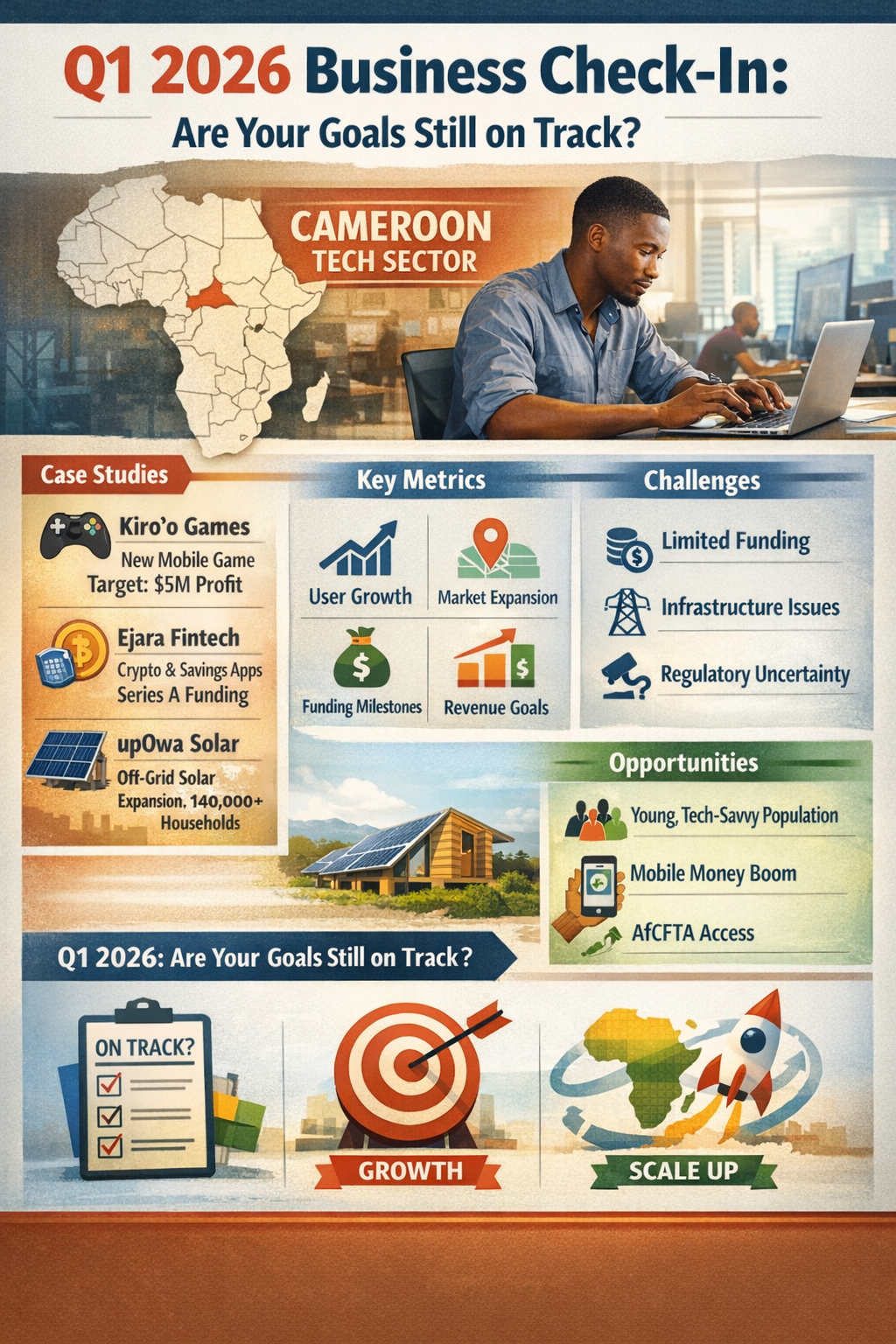
Cameroon's tech ecosystem offers valuable lessons for all entrepreneurs. With over 1,250 registered startups and approximately $148 million raised in total funding as of January 2026, our nation's business landscape is evolving rapidly. Yet, the same data reveals a sobering truth: low startup survival rates and limited capital remain persistent challenges.
Let's use this mid-Q1 moment to honestly assess where your business stands and make strategic adjustments for the rest of 2026.
Before diving into your own review, it's helpful to understand what metrics matter. Looking at Cameroon's leading startups reveals the key performance indicators that separate those making progress from those spinning their wheels.
Are more people using your product or service than in December? Kiro'o Games, Cameroon's pioneering gaming studio in Yaoundé, focuses relentlessly on expanding its player base toward an ambitious goal of 60 million African users. Their recent game demo attracted 85,000 downloads—a tangible milestone showing they're building real traction.
For your business, ask yourself: What does growth look like? Is it more customers, more repeat purchases, higher engagement, or expanded reach? If your numbers haven't moved significantly since January 1st, you need to understand why.
Successful Cameroonian businesses aren't just growing deeper—they're growing wider. Fintech companies are expanding payment services across the CEMAC region. Even with infrastructure challenges, they're finding ways to reach new cities and cross borders.
Have you made progress on geographic expansion, new customer segments, or additional distribution channels? If your market expansion goals are stalled, February is the time to diagnose whether it's a resource issue, a strategy problem, or simply poor timing.
Ejara, the Douala-based fintech platform, provides a masterclass in progressive fundraising. They raised $2 million in seed funding in 2021, followed by an $8 million Series A in 2022. Each funding round enabled specific roadmap achievements: new product features, team expansion, and market penetration.
Whether you're bootstrapped or seeking investors, financial milestones matter. Have you hit your Q1 revenue targets? If you planned to raise capital, are you making concrete progress toward that goal? Or are you hearing the same phrase many Cameroonian entrepreneurs face: "It's too early"?
UpOwa, the solar energy startup bringing power to off-grid villages, demonstrates the importance of product evolution. Their shift from basic solar kits to larger, more sophisticated systems reflects strategic product development aligned with customer needs and market realities.
What product improvements did you promise yourself in January? Have you shipped new features, refined your offering, or enhanced customer experience? Unfinished product development can quickly become a bottleneck that stalls everything else.
Kiro'o Games has set a clear financial target: $5 million in profit within three years. Whether or not they hit that exact number, having a concrete revenue goal keeps the entire team focused and accountable.
How does your Q1 revenue compare to your projections? If you're behind, is it because of slower sales, pricing issues, higher costs, or delayed launches? Understanding the gap is the first step to closing it.
Let's be honest about the environment we're operating in. Sugarcoating reality doesn't help anyone build a sustainable business.
Cameroonian startups struggle to attract the investment levels seen in East or West Africa. The reasons are complex: limited managerial expertise in some cases, risk-averse investors, and a relatively young ecosystem. Even when companies show promise, many hear that investors think "it's too early" for Cameroonian ventures.
If funding challenges are derailing your 2026 plans, you have three options: adjust your strategy to require less capital, pursue alternative funding sources (microfinance, crowdfunding, grants), or double down on revenue generation to fund growth organically.
Frequent power outages and limited internet penetration (only about 16% of available cable capacity is being used) make digital operations unnecessarily difficult. These aren't excuses—they're real constraints that need real solutions.
Have you built contingencies into your business model? Solar backup power, offline-capable systems, or partnerships that help you navigate infrastructure challenges? Your Q1 review should include an honest assessment of how much time and money you're losing to infrastructure issues.
The competitive landscape shifted dramatically in early 2026. Camtel, the state-owned telecommunications company, launched its "Blue Money" mobile money service, adding intense pressure on private fintech players who already compete with MTN and Orange.
Competition isn't just a fintech problem. Whatever sector you're in, February 2026 likely looks different than you imagined in December 2025. Are your competitive assumptions still valid? Do you need to sharpen your value proposition or differentiate more aggressively?
E-commerce, cryptocurrency, and many digital services operate with unclear regulatory frameworks in Cameroon. This uncertainty makes long-term planning difficult and can lead to unexpected setbacks.
If regulatory ambiguity affects your business, your Q1 check-in should include a contingency plan. How would you adapt if regulations suddenly tightened? What relationships or advocacy efforts might help shape favorable policies?
Despite real challenges, Cameroon's entrepreneurial environment offers genuine opportunities for those who know how to leverage them.
Over 60% of Cameroonians are under 25 years old, creating both a talented workforce and a growing market for digital services. High mobile penetration and rapid mobile money adoption are fueling innovation, particularly in fintech and digital services.
Are you effectively reaching this young, mobile-first audience? If not, what needs to change in your marketing, product design, or distribution strategy?
Programs like the Enovation/UNDP "Scale 32" accelerator launched in late 2025 to support 32 startups from January through June 2026. Government policies are also improving—a 2024 decree eliminated import duties for incubated ventures, making equipment more affordable.
Have you explored available accelerators, grants, or government incentives? Many entrepreneurs leave money and support on the table simply because they don't know what's available or don't prioritize applications.
The African Continental Free Trade Area promises a larger market and more harmonized regulations for businesses that can export across borders. This creates opportunities for Cameroonian companies to think beyond national boundaries from day one.
Does your business model account for regional expansion? Even if you're focused on Cameroon now, are you building in a way that makes future expansion possible?
Now it's time to get specific about your own business. Grab a notebook and honestly answer these four questions:
List your concrete achievements. Not what you worked on or tried—what you actually completed and shipped. Compare this to your January goals. The gap between intention and execution tells you a lot about your planning accuracy and execution capacity.
If you accomplished less than planned, why? Was it unrealistic goal-setting, resource constraints, unexpected obstacles, or simple lack of focus and discipline?
Pull your actual numbers: revenue, customers, users, website traffic, conversion rates, production output—whatever matters for your business model. How do they compare to December 2025 and to your January 2026 targets?
Flat or declining metrics aren't always bad—sometimes they reflect necessary pivots or seasonal patterns. But you need to understand what's driving the numbers and whether the trends are sustainable.
Every business plan contains assumptions. Maybe you assumed customers would pay a certain price, that a partnership would materialize, that a supplier would deliver on time, or that marketing would generate specific results.
Which assumptions already proved incorrect in the first six weeks of 2026? Acknowledging failed assumptions isn't admitting defeat—it's gathering intelligence that makes your next move smarter.
Based on your answers above, what must you adjust immediately? This might be:
The key is specificity. "Work harder" isn't a strategy. "Shift marketing budget from Facebook to WhatsApp campaigns targeting market vendors in Douala" is a strategy.
The most successful Cameroonian startups didn't succeed by rigidly sticking to their original plans. They succeeded by staying focused on their mission while remaining flexible about tactics.
Ejara's Trust-Building Pivot: After crypto market turbulence and events like the FTX collapse shook investor confidence, Ejara didn't abandon crypto—they adapted. They introduced non-custodial wallets (giving users direct control) and expanded into tokenized government bonds for savings. This pivot addressed market concerns while expanding their value proposition.
Kiro'o's Platform Shift: After successfully launching Cameroon's first Xbox game, Kiro'o is now pivoting to mobile gaming with their multiplayer game "Elites of Mboa." They recognized that mobile reaches far more African players than PC or console gaming. Rather than viewing this as abandoning their achievement, they're building on it by meeting customers where they are.
UpOwa's Model Refinement: The solar energy company initially set aggressive targets—1 million people with solar power by 2023. While they haven't hit that exact number (reaching about 140,000 people with 28,000 active systems), they've remained focused on sustainable growth through their pay-as-you-go model and expanding agent networks. They adjusted timelines without abandoning the mission.
What can you learn from these pivots? Successful entrepreneurs stay committed to solving a real problem while remaining flexible about exactly how to solve it.
Let's talk money. If your business runs out of cash, nothing else matters. Your mid-Q1 review must include a hard look at financial sustainability.
How many months can you operate at your current burn rate before running out of money? If the answer is less than six months, you're in the danger zone and need immediate action.
Is monthly revenue growing, flat, or declining? What's driving the trend? Look beyond the top-line number to understand what's really happening with customer acquisition, retention, and average transaction size.
Are your costs in line with projections, or are you spending more than planned? Where specifically is money going? Are there expenses you can cut without significantly damaging operations?
When will you break even? If that date keeps getting pushed back, you need to understand why and decide whether to accelerate revenue, cut costs, or secure additional funding.
For Cameroonian entrepreneurs facing capital constraints, profitability often matters more than growth. A smaller, profitable business is better than a fast-growing one that collapses when funding dries up.
Here's what you should do this week to get back on track:
Monday-Tuesday: Assess
Wednesday-Thursday: Strategize
Friday: Communicate
Weekend: Prepare
The beauty of conducting this check-in in February is that you have ten months left in 2026. That's plenty of time to recover from a slow start, capitalize on early momentum, or pivot entirely if needed.
Remember these principles as you move forward:
Progress over perfection: You don't need to hit every goal perfectly. You need to show consistent forward movement and learn from setbacks.
Resilience over rigidity: The entrepreneurs who succeed in Cameroon's challenging environment aren't the ones with perfect plans—they're the ones who adapt intelligently when reality diverges from the plan.
Sustainability over speed: With limited capital and infrastructure challenges, building a sustainable business often matters more than building the fastest-growing one.
Relationships over transactions: In Cameroon's tight-knit business community, your reputation, partnerships, and network often determine success as much as your product does.
Taking time for a mid-Q1 review might feel like a luxury when you're buried in daily operations. But it's actually a necessity. Without periodic course corrections, even hardworking entrepreneurs can spend months heading in the wrong direction.
The Cameroonian tech ecosystem proves that success is possible despite real constraints. Companies like Kiro'o Games, Ejara, and UpOwa are building meaningful businesses by staying focused on their missions while remaining flexible about tactics. They track what matters, pivot when necessary, and keep pushing forward even when progress feels slow.
You can do the same.
So this week, set aside time for your honest Q1 check-in. Pull the real numbers, ask the hard questions, and make the necessary adjustments. Your February decisions will shape your December results.
The year isn't lost or won in January—it's built through consistent, honest assessments and smart course corrections throughout all twelve months.
Are your goals still on track? If not, now you know what to do about it.